Sub-Header

I wanted to put a link to the original Adventure Time clip on youtube here, but I can't find it. Here's one elsewhere, I think... http://www.funnyjunk.com/movies/1130587/
Your life will be richer for watching it ;)

Thursday, 7 March 2013

The Otago Peninsula

Dunedin is a pretty cool place - you could spend a week here and not run out of things to do. Its full of really cool old buildings from the 1880s onwards - great big stone affairs with clocks and bells and pillars and staircases.
The Otago Peninsula
Yesterday afternoon I headed out to the Otago Peninsula, home to abundant coastal sea life and New Zealand's only castle.

Larnach Castle
Larnach Castle was built between 1871-1887 by William Larnach, apparently for his wife (who wasn't all that impressed), but more likely because I wanted a fancy house. The less-than-happy-Larnach family had a rather tumultuous history. William Larnach went through three wives (the last of which was 25 years his junior and had an affair with his eldest son) and 6 children. After his first wife died, he signed all of his property into the name of his second wife (the first wife's sister, whom the children disliked) because he was afraid he'd go bankrupt. Which he did. But then she died, and all the money passed to his kids, so he tricked them into signing it back to him; he then proceeded to put it all in the name of his third wife. Then he killed himself. Then half the kids sued to get the money from the first wife, and won. Then the oldest son killed himself, two of the girls died in their early twenties, and the whole unhappy story continues in a similar manner.

Butterfly in the gardens at Larnach Castle
The castle had been long abandoned and was falling apart when the current owners bought it in 1967 and fixed it up as their family home; with the kids all grown up, they no longer live there and use the house as a museum.

Sleeping sea lion
From there I proceeded to visit some of the beaches along the peninsula. The peninsula was formed by volcanic activity, and its steep, hilly geography is mostly the result of lava flows carved by the wind and buried in sand. I saw some sea lions, and visited "Sandfly Beach" - not named after the annoying little bugs, but rather after the fact that it is SO WINDY that the sand quite literally flies. They had penguins. :) VERY windy though - can't-walk-in-a-straight-line-because-you-get-blown-off-course windy. :p The waves were huge, and you could see rainbows in the spray above them.

Down at the stadium of the university here in Dunedin, there is currently a 5 (yes, FIVE) day long cricket match going on between the NZ team and the English. Several of the people at the hostel came all the way from England just for that (and the one following it in Wellington - again, five days. One match. Five days. Yikes). Apparently the English are losing - badly.

Box reads:
"The greatest jig-saw problem of the age.
THE PUZZLE OF EUROPE
The Nazis have battered their crooked sign
into the face of Europe, shattering nearly
all of it - except Britain.
The task that lies before us is
that, whatever the cost, we must -
PUT EUROPE TOGETHER AGAIN!"


Model of a floating staircase in
the museum. Incidentally, the only
floating staircase in the Southern Hemisphere
(or it was at the time of building, or something),
is inside Larnach Castle.
Yesterday morning I paid a visit to the Otago Settlers' Museum - where there was an interesting puzzle (see photo) and lots of late Victorian recipes. I'll have to give some a shot at work this summer. :)

1890s day dress... appropriate for
the Fort, which is why I took a picture :p


Tuesday, 5 March 2013

BEST MILK EVER

In other news: I just poured myself a glass of milk and it is, without question, the BEST milk I have ever had. Yum.

The Chocolate Factory

Before talking about the chocolate factory, I just need to mention that I've finally reached Hogwartz. And no, I did not forget how to spell :p - the hostel here in Dunedin is called Hogwartz. Hands down the coolest place I've stayed so far - so much so that it deserves its own post, perhaps tomorrow. :)

And old box of chocolates, these ones English.
(Cadbury bought the Dunedin factory relatively
recently; its always been a chocolate factory,
but not always owned by Cadbury).
Right now though, chocolate. I arrived in Dunedin completely unaware that it housed New Zealand's largest chocolate factory. Older than most of the Fort back home, this gigantic chocolate factory runs 24/7, churning out delightful treats for all of NZ and Australia. It used to make all the Cadbury chocolate for the south, but other factories have since opened up, allowing this one to specialize - mostly in treats that they don't have at home. Thats right - there's a whole different chocolate scene going on down here. I'd noticed that in the grocery stores; Cadbury bars like "Flake", "Picnic", "Turkish Delight", the oddly popular chocolate covered fish shaped marshmallows, and individual chocolates including "Rose", "Freddo", and these tasty chocolate covered balls whose name I forgot.

A couple of the original company cars
So I went on a tour of the chocolate factory. It was me and an older Australian couple, and we definitely got lucky - the tour in front of us had about 20 people on it. The lady giving us the tour has worked at the Cadbury factory in Dunedin for 18 years - and for her whole life, she has not liked chocolate! I guess that solves the problem of making yourself sick eating too much of it at work... but she does like the marshmallows, she says. And the caramels. To the point that she will chip the chocolate coating off the caramels and then eat it.

Chocolate Silos
The white one is where they store
nuggets of not-yet-processed chocolate.
The purple one houses the pointless
but kind of cool chocolatefall.
I got to try several new kinds of chocolate, see a giant chocolate waterfall. I was confused as to its purpose though, so I asked. As it turns out, it has no purpose. One of their engineers built it for fun in a giant silo about 10 years back and they just use it for tours. :p

I couldn't bring my camera into the actual factory so pictures in this post are limited. Also sad: they aren't allowed to sell seconds at this factory (but they can at the one in Australia), so there was not heaps of cheap chocolate. But there were many samples, now safely stowed in my belly (not entirely true - about half of it is still in the car... I should move that before it gets warm in there tomorrow... though it was cold and rainy today (Tuck FINALLY got a bath!!!) so it may not get hot enough to be a problem).

The other people on the tour were hilarious. Both the tour guide and the wife were rather opinionated old women, resulting in some pretty entertaining conversations.

Train Station
Now as you all know, I am not too keen on cities. At all. But as far as the ones down here go, Dunedin is certainly my favourite one so far. Many huge, lovely old stone buildings from the late 19th century, and the city centre is built around a road aptly named "the Octagon." Essentially there are two concentric circular roads wrapped around the whole historic downtown district. There is the original train station from 1904 - it is enormous, and was the busiest station in the country at the time. Lovely lobby with a wrap around balcony, carved mouldings, tile mosaics and stained class windows (with trains and lions in them :p ).

They like their signs-that-point-everywhere
here
Inside the train station
And up the hill a bit of course, there is Hogwartz. (Parking was a nightmare though - steep hills, sharp corners, and a massive amount of construction focused on a 100 meter radius of the hostel. But it all turned out okay. Eventually). Usually when I go for a walk I take note of a few landmarks so I can find my way back. I made the mistake of using "the big church" as one of these... there are at least 7 big churches within less than a 1 km radius haha. Wasn't a problem though. :p
Inside the train station

Tomorrow: the Otago peninsula, to hopefully see some Albatrosses, (Albotri? haha no :p ), penguins, possibly some sea lions, and in all likelihood a castle, since that isn't likely to swim/fly away.


Do not use churches as landmarks.


The Catlins... sheep country!

Everybody told me there would be sheep. Lots of sheep. 50 million sheep, 5 million people, etc. But to be honest, up until today, the whole "so many sheep!" thing has been a bit of a disappointment. On the north island, I'm pretty sure I saw more cows than sheep...

But today (and yesterday), I found the sheep. Did I ever... they've stashed them all away on the east coast of the south island, it appears.

Lighthouse at Nugget Point
I'm currently in a region known as the Catlins - known for its fast changing weather, rugged coastlines, and rainforest-turned-farmland... sheep country. But first a typical aside on geology.

Back in the day, New Zealand was part of the most recent supercontinent, Gondwanaland (ring any bells from grade school? Or is everyone still hung up on Pangaea?) While the North Island has had some substantial volcanic activity, and the west side of the South Island is experiencing massive uplift, the east coast of the South Island has been shaped mostly by the wind and the waves. The result is pretty cool - ancient species of trees found nowhere else (actually, there's a species of pine found here and in Chile, of all places...), huge sea caves in the cliff faces going hundreds of meters inland (sometimes collapsing to make blowholes in the middle of pastures high up on a hill), and an entire fossilized forest from the Jurassic period emerging on a beach at low tide.

Geology aside complete. On to the fauna. The coast is the home to several species of penguins, sea lions, whales, and dolphins. Speaking of dolphins, apparently there has been some crazy sort of dolphin gathering up in the Cook Strait, between the N. and S. Islands - hundreds of dolphins frolicking in the strait and right into Wellington Harbour; apparently you could even see it from airplanes. But that's a ways north of me, at the moment.

Ricey. Age 27. Ex-racehorse. Likes to nuzzle.

Right. Sheep. Lots and lots of sheep. I went horseback riding again, this time with a horse named Ricey - the best horse I have ever ridden. No offence, Pete. Super-nice family run farm, and much less touristy than last time, which was nice. Ricey's older than I am, and lives on a big... organic sheep farm! There are some cows, too, but they keep around 2500 sheep year round, and right now its about double that because of the lambs. On one farm. One family. Many sheep. White sheep, black sheep, white sheep with black faces... cute, the lot of them.

Traffic
I got stuck behind a large number of lambs being moved down the road to a new pasture - all legs and bouncing heads in a river of fur being moved down the road by about 10 dogs and two pickup trucks. Occasionally they'd do a little jog and there would be a big ripple of ears as they bounced a little faster. :p A couple times one would just fall over, though (scared?) and the farmer would get out of his truck and put it in the back, by which time it had woken up and started bleating. The dogs certainly knew what they were doing, and seemed to be enjoying themselves.


Clouds in the Catlins
Pūrākaunui Falls
The sky here is huge - and often full of interesting cloud formations. The weather changes pretty quickly, though it still hasn't rained enough in one go for Tuck to get a proper shower. Looking out over the landscape, you see mostly fields with patches of forest here and there. At the turn of the last century, it was all rainforest - no grasslands to speak of. The native forest is lovely - orchids, ferns, and rimu and other podacarps (think broad-leafed, super-lush almost-pine tree).  From a distance though, you'd never guess what was hidden under some of the trees in the valley bottoms. The landscape is laced with small rivers and streams which feed into the large, wide estuaries; beneath the shelter of the trees, though, these smaller streams cascade over many small but gorgeous waterfalls.

Hostel in the Catlins
The hostel where I'm staying in the town of Owaka (the largest town in the Catlins... population 334 at the last census - speaking of which, it was census day in New Zealand today! I got to fill out a census form :D ) is an old hospital from the first half of the 1900s... haven't found the exact date anywhere, just guestimating... windows like the Fort's school house :p. Its huge, and mostly empty since not a lot of people come through here, making for potentially eerie nights. Definitely a quirky building, in a quirky town with a quirky population. :p

Tomorrow: Dunedin.

P.S.
I've got a pile of pictures I want to stick up on Flickr, but I'd like to do them full sized (therefore not over my data stick). Usually the busier YHA's have free internet so hopefully in a couple of days I'll get some up.

I'll leave you with a few pictures of sheep. :p


Monday, 4 March 2013

A Short Hike


Yesterday was my last day in Fiordland. :(
I went for a hike!  :)


The road into Fiordland park
An hour and a half's drive into Fiordland National Park brought me to The Divide, the mouth of one of the Routeburn Track. The Routeburn is one of New Zealand's "great walks" - well travelled, multi-day walks with Department of Conservation maintained huts scattered along the length (bookings required, usually filling up several months before the travel date, so don't bother checking the weather :p ).

A little ways along the Routeburn Track a side trail branches off up to Key Summit. The trail eventually rises above the tree line, ending up in a different kind of alpine meadow than I'm used to! Most of this mountain range is composed of exposed rock with little soil, thus not much by way of nutrients. However, moss thrives with the heavy rainfall. Over time layers and layers of moss grow over top of one another, with the bottom ones dying and decaying into peat. The rain forms pools in these moss-bogs.

sundew (maybe, I really should check the name)
The carnivorous flower :)
The meadows and side hills also boast many small shrubs, grasses, orchids, and the sundew flower (I think that's what it was called), which deals with the low nutrient content of the soil by eating bugs. Yep, a pretty white carnivorous plant! :p

The super-strong gusts of wind and lack of large quantities of dirt kept trees pretty small higher up, but the forest gets denser as it nears the valley floor. Most of the trail was beneath a lovely canopy of beech trees, with little waterfalls coming down the mountain side (and the occasional large mud-and-tree slide left over from spring).

From the summit was a lovely view of the surrounding higher peaks, hanging valleys, and glacial moraines.

In the afternoon I headed back to Te Anau and explored the little town. Of interest to some - Lake Te Anau is actually part of a rather large underground hydro-electric power generating facility. (Underground in the literal sense, not the illegal sense). The multi-lake system generates power by allowing water to flow through underground channels from the higher lakes to the lower, with the hydro facility located at the big drop underground.

Current location: The Catlins. I've got a four bed dorm to myself. :p

(also, usually the sand flies leave me alone. But a few got caught in the car with me yesterday and bit my toes, so I had to stop and put on bug spray. To drive. Not to hike, or eat lunch. Just to drive...)

50 Shades of Green

Fiordland National Park
 As a whole, New Zealand has been much less green than I expected. Of course, it is the end of a hot, dry summer, so the grasses are yellow and there's lots of dust, just like home at the end of August. The exception to this? Fiordland. Despite currently being in a drought, most of the foliage is still green. Pine trees, beech trees, ferns of all shapes and sizes, shrubs, grass, little flowers, vines, lichen, and covering everything, moss. So many different kinds of plants, each one a slightly different colour than the last! And when the sun twinkles through the canopy, surreal colours that I just couldn't catch... but I tried. So here are some pictures of green things! :)
Moss-bog just below Key Summit, on the
Routeburn Track, Fiordland National Park
Fiordland National Park

Blues and greens along The Chasm,
Fiordland National Park


Fiordland National Park

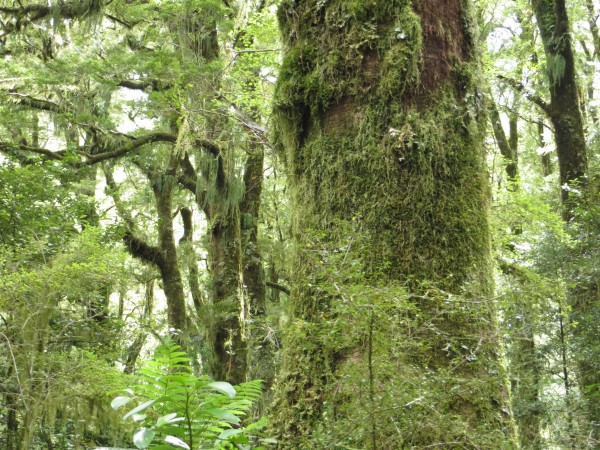
Mosses growing off the trunk of a tree in
part of the small, undisturbed forest on Bluff
hill.

Moss, ferns, grass, brush, and trees in the
morning sunlight along the Routeburn Track


Silver Beach forest in Fiordland National Park

Friday, 1 March 2013

Milford Sound


Yesterday was March 1st - the 1st day of fall! Of course, most of the beach forest on the South Island and all of the sub-tropical stuff is continuously shedding and budding leaves, but there are poplars and other deciduous trees down here that will actually do the whole turn gold and drop leaf thing.

Seals! There aren't any predators for them
in Milford Sound, so young males tend to 
flock here

We took a boat around Milford Sound (which is actually a fjord, not a sound: glacier formed, not river formed). Funny fact about the boat. It was a three-masted, engine driven affair built to look like the merchant ships that used to sail the coasts of New Zealand. However, all the sails were included with the boat, whoever built it neglected to add a keel... so you can't actually use the sails to move. Hence the engine.

We got up just before sunrise and got on the great big bus which would take us through the Southern Alps to the fiords on the other side. The bus driver was spectacularly hilarious. Here's a small taste of the running commentary he kept over the two-and-a-bit-hour (each way) drive:
"I'm your 'nature guide.' I have no qualifications, its just a fancy name for
We stopped off at the Mirror Lakes on the
way to Milford. I liked the sign :p
driver."
"My mother always said that little boys who tell lies grow up to become weather forecasters."
And this little joke the bus driver had as we wound our way along the narrow road cut into the cliff face of a mountain: "A little boy was talking to his granny after his grandad's funeral. He said, 'Granny, when I die, I want to go like grandad, nice and peacefully in my sleep. Not yelling and screaming, like the passengers on his bus as they went off a cliff'."
The commentator on the boat was equally amusing. As we were leaving: "Those of you who drove... make sure you have your cars..."

It was a sunny day; though this meant that we didn't get wet, it also means that most of the waterfalls along the walls of Milford Sound were dry. Fiordland, one of the wettest places on Earth (earth or Earth? earth for dirt, Earth for the planet?), is in the middle of a pretty bad drought, but nonetheless the drive and the fiord itself is still the most beautiful place I've seen down here so far. So much so, in fact, that I've stayed for an extra couple of days.

If you haven't noticed by now, I kind of like rocks. A lot. And general geology/natural history stuff. So if this sort of thing bores you, skip the next few paragraphs :p (but I'll keep it "short", I promise!)

As I mentioned, Milford Sound is not actually a Sound. Carved out by glacial movement, it is technically a fjord (I think they use the word fiord here, so I might be switching up my i's and j's. Hopefully iust jn that word though. Not all the rest of the tjme. ;) ) The Southern Alps of Fiordland are extremely young for mountains. They are located in one of the most geologically active parts of New Zealand, right on the Ring of Fire. There is a fault running right down the side of one of the mountains where no trees grow because it slips too often. The Pacific Plate is colliding with the Indo-Australlian plate, which has pushed up over 20km of crust to form the Southern Alps mountain range. But the mountains aren't actually 20km high :p - erosion has kept tabs on that, with the tallest mountain being Mount Cook, at 3754 metres. But back to the mountains right around Milford.

The pictures don't do much justice to the size of the place - those mountains around the edges are around 1700m high. The near-straight cliffs plunging down to the water keep going below the surface - the depth less than a boat-length away from the wall of the fjord was over 200 metres. Deep. The water had that same surreal blue-teal tint seen in the rivers along the west coast.

The icy water in the streams higher up in the mountains of Fiordland were unbelievably clear - and the most beautiful blue. Fun fact - these rivers stay the same colour during spring floods. The mountains don't have any topsoil - they're just exposed rock. The rock walls are so steep that if any soil tries to build up it is immediately washed away, thus when it pours, the flood water remains clear.

The valley floors are populated largely by beautiful red beech forests, with silver and alpine beech growing higher up. The walls of Milford Sound were largely covered by dense growths of beech forest. However, since there isn't much by way of dirt, to anchor themselves the roots of big swathes of trees are all tangled together. But sometimes one tree will lose its grip on the rock, and the weight of that one tree slipping is too much for the rest of the trees tangled in with it to hold up - so the whole swathe rips off the side of the mountain and goes plunging down to the fiord or valley below.

Avalanches are a little different in this area as well. You get the "usual" kind like those at home, but you also get giant snowballs which shoot off the side of the vertical cliffs, and plummet a kilometre or more to the valley floor. The fall, and the impact, creates wind bursts of up to 200 km/h, flattening trees in a radius around the fall.

The beech forests were beautiful. The streams were beautiful. Nice mountains, too. :p Milford Sound itself of course was quite spectacular. Saw lots of seals, and a brief glimpse of a couple of penguins. :)

Oooo I haven't talked about the tunnel, yet! So the road to the coast starts on a valley bottom (a big moraine grown over with forest) then starts climbing up the side of a big u-shaped glacial valley. A dead-end valley, with a very tall cliff face at the end. With a small hole in the side. A tunnel! The 1.2 km long Homer Tunnel. The tunnel was constructed starting on the higher side. When they got partway into the mountain though, they discovered that it wasn't solid rock. There were fissures inside the mountain with water flowing through - and they were effectively digging a hole. Which filled up with water. Quite quickly. So pumps had to be brought in to drain the tunnel until they broke out the other side.

Lovely place. Also the most like home. I think I've been rather spoiled in the gorgeous scenery department, growing up in the East Kootenays.

This morning Janna and I drove to Invercargill so she could catch her flight to Christchurch. After dropping her off at the airport, I headed a little further south to Bluff, the almost-but-not-quite-southernmost tip of the South Island. Went for a lovely walk through some native forest (for once, the cicada's weren't making a racket - instead I got to listen to warblers singing for an hour and a half. It was marvellous), then got back in the car and drove back to Te Anau.


The lake here at Te Anau is the 2nd biggest in NZ by area after Taupo (the big one in the middle of the north island), and the largest in terms of water volume (its quite deep. Again, glacier formed - carved out by receding glaciers then filled with melt water as we came out of the last glacial maximum). (Don't cite me on any of this, I'm just going by memory of what I read and only occasionally verify my facts before posting :p ).

I passed lots of sheep and deer farms. On the way to Bluff there was even a stretch of farms with big white tail deer. Some of the sheep had been sheared, while others were still fluffy. Sometimes there was a mix of the two in one field. I wonder if the shorn sheep feel embarrassed when they have to go stand with the fluffy ones...


Also, my shoes are falling apart. Now water and small particles of forest floor sneak up on my toes. I love these shoes. They have been wonderful. Maybe I can glue them back together...